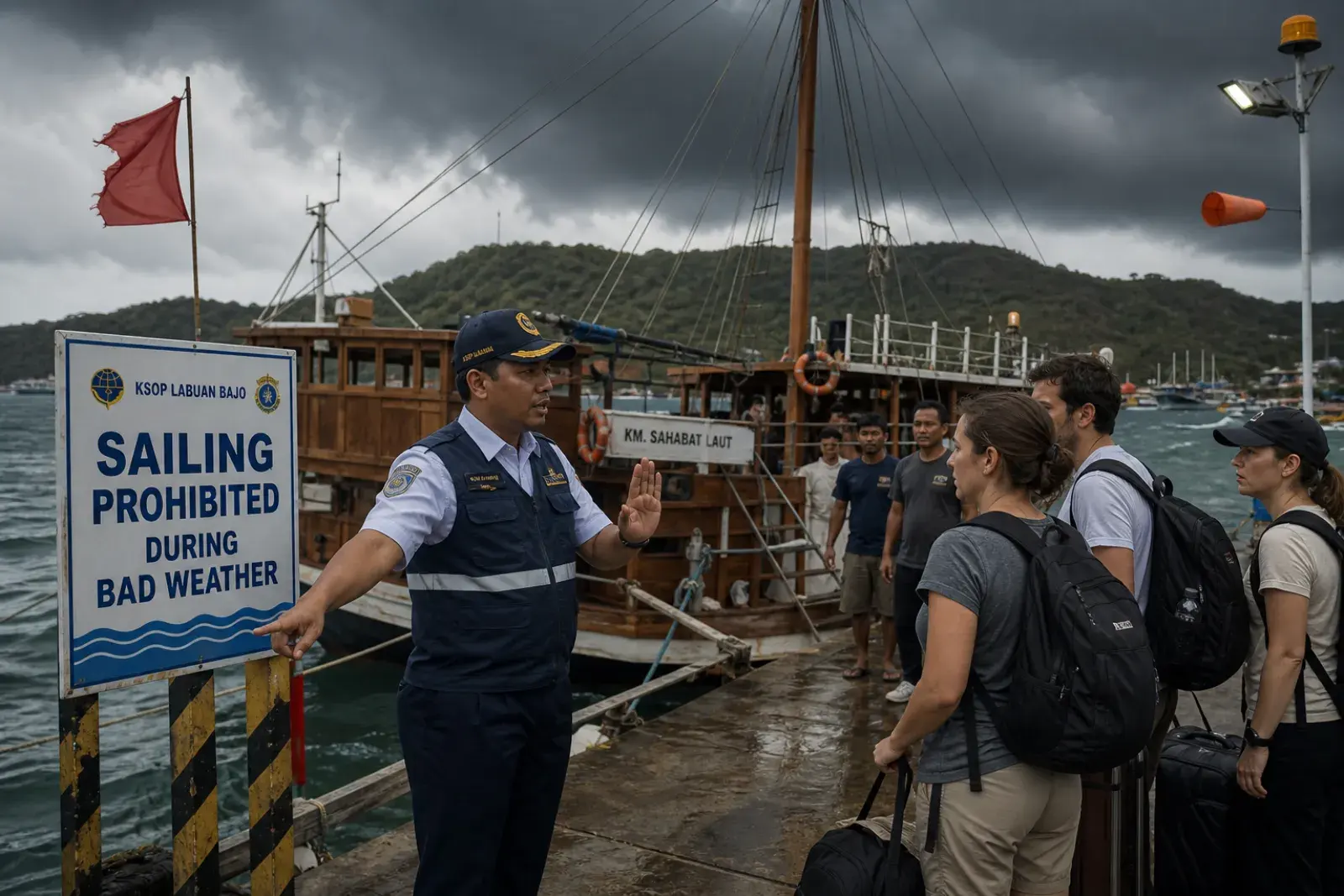

You have booked your Komodo trip, and then you see it: bad weather rolling in around your dates, or news that boats are being held in port. The worry hits straight away, is the trip off, and what happens to the money you already paid? It is a fair question, and the answer is reassuring. If your Komodo trip gets cancelled because of a sailing ban, that is force majeure, and with a proper operator you get a full refund or a reschedule, not lost money. A sailing ban (larangan berlayar) is when the harbour authority in Labuan Bajo holds all boats in port because the weather is dangerous, purely for safety. It does not happen often, but it is real, and it is most common during the west monsoon around the turn of the year. Here is what it is, when it tends to happen, and exactly what happens to your money if your trip is affected.
What is a sailing ban?
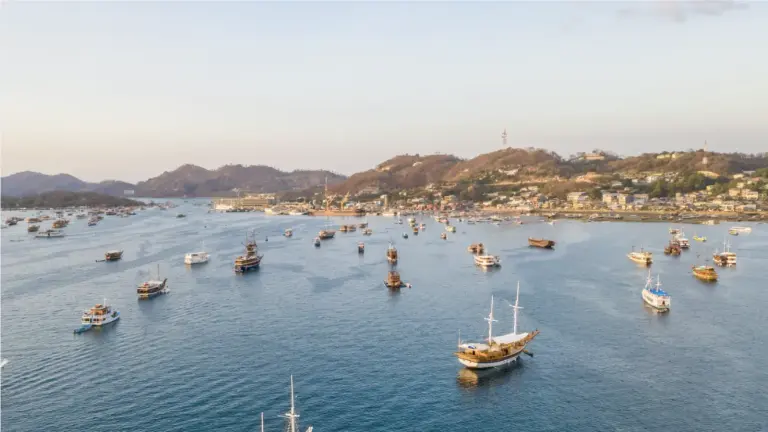
A sailing ban is an official decision by KSOP (the harbour and port authority) in Labuan Bajo to keep every boat in port, from large tour boats to speedboats, when conditions are unsafe. It is not arbitrary: KSOP bases it on maritime weather forecasts from BMKG, the national meteorology agency, plus reports from boats already at sea. The mechanism is simple: KSOP withholds the SPB (the sailing approval letter), so legally no boat may depart until the ban is lifted. In short, it is a safety system, not red tape.
When KSOP imposes a ban it issues a formal, numbered sailing notice (a maklumat pelayaran) that applies to every vessel until it is revoked. The call tracks specific conditions: significant wave height, wind direction and speed (in the west monsoon the wind runs from the west and northwest), and gusts that can climb well above the average. Boats already at sea are told to shelter or moor in protected bays with engines on standby. So a ban is a coordinated safety decision, not one person's whim.
When does it tend to happen?
Most often during the west monsoon, roughly December to February, when wind and swell are at their strongest. Honestly, though, there is no fixed schedule, because it follows the weather, and it does not always take the same form. In late January 2026, KSOP suspended SPB processing entirely for all tour boats (including speedboats) from 29 January to 1 February, until the weather improved. But in May 2026, when swells in the southern Sape Strait rose to 2.1 metres, it was not a full closure: SPB was still issued, but only for the nearest route (destination Rinca), with a mandatory safety briefing and no night sailing. So depending on how bad the weather is, it can be a full closure or just a restriction. What decides it is BMKG and the conditions on the day, not the calendar, so the dry season (roughly April to October) sees far fewer, though it is never impossible.
Why a sailing ban is actually good news
We know that being grounded mid-holiday is frustrating. But look at it the other way: the sailing ban is what protects you. The real danger is not the ban, it is an operator who sails out in bad weather anyway to avoid a refund. This is not theory: in December 2025, KM Putri Sakinah set off with a group of tourists despite a BMKG extreme-weather warning, and it ended in tragedy, with lives lost. The captain and a crew member were later jailed for the negligence (source). We break the case down, and how to make sure your boat is safe, in Komodo boat safety. A proper operator follows the KSOP ban and offers you a way out instead of taking the risk. So if your guide or operator tells you the trip is postponed because of a sailing ban, that is a sign they put your safety first. Labuan Bajo has tightened safety enforcement after a run of boat incidents, and stricter sailing bans are part of that. It is a sign the system is working in your favour, not against you.
What happens to your Komodo trip if it is affected?
This is the part you most want to know. If a trip is cancelled because of a sailing ban or extreme weather, it counts as force majeure, which is different from cancelling yourself. With Open Trip Komodo, force majeure means a full refund or a reschedule, not lost money. The reschedule is flexible, up to 6 to 12 months ahead, so if you cannot come back soon, your seat is not lost. Compare that with a voluntary cancellation, where the refund depends on how far ahead you cancel: full refund 30 days or more before departure, 70% at 14 to 29 days, 50% at 7 to 13 days, and nothing inside 7 days. That is exactly why it pays to confirm your operator has a clear force-majeure policy before you pay.
What if you are already in Labuan Bajo when a ban hits?
It is not the end of your trip, just a pause. While the sea is closed, Labuan Bajo and the mainland still have plenty to do on land: the town and its harbour-front cafes, the Batu Cermin cave, the Cunca Wulang canyon and waterfall, or a sunset spot over the bay. A good operator keeps you updated on when the ban is likely to lift and slots your trip into the next safe window, or reschedules it for later if you have to fly out. The one thing not to do is pressure an operator to sail anyway. If they agree, that is the operator you should have avoided in the first place.
How to prepare so you do not panic
A few small things make this far less stressful:
- Do not book a trip tight against your flight home. Leave a day or two of buffer. If the trip is postponed by a ban, you have room and will not miss your flight.
- Pick calmer-sea timing if you can. The dry season (roughly April to October) is far less likely to see a ban than the peak of the west monsoon.
- Make sure the operator's force-majeure policy is clear. Ask upfront: if there is a sailing ban, is it a refund or a reschedule? A proper operator has a written answer.
- Watch the weather as departure nears. BMKG issues swell forecasts, and a good operator will tell you early if a ban looks likely.
If you are weighing safety more broadly, we cover it in full in is an open trip to Komodo safe.
Do I get my money back if my trip is cancelled by a sailing ban?
Yes. A sailing ban counts as force majeure, and with Open Trip Komodo that means a full refund or a reschedule, not lost money.
How long does a sailing ban usually last?
It depends on the weather and follows BMKG data. It can run from a few days to about a week, and it is sometimes extended if conditions do not improve. The late-January 2026 closure, for example, ran from 29 January to 1 February, until the weather improved.
How is a sailing ban different from cancelling myself?
Very different. A sailing ban is force majeure: a full refund or reschedule. A voluntary cancellation is refunded by timing: full refund 30 days or more before departure, 70% at 14 to 29 days, 50% at 7 to 13 days, nothing inside 7 days.
Which season sees the most bans?
The west monsoon, roughly December to February. The dry season, April to October, sees far fewer, though not zero; in May 2026 sailing was restricted when swells hit 2.1 metres.
Can a boat sail anyway if there is a ban?
No. Without the SPB it is illegal to depart, and any operator who does is putting you in real danger. A ban applies to every vessel, including private charters and speedboats, so a boat that offers to take you out during a ban is the clearest red flag there is.